Baja SAE is one of SAE International’s Collegiate Design Series (CDS) competitions that challenges students design and build an all-terrain, single seat vehicle. The vehicle that they design is tested in various competitions. The design of the vehicle must adhere to the design rules for competition and safety put forth by SAE International CDS, and is intended to be marketed towards the recreational user.
Design Considerations
Many of the design considerations for designing a Baja SAE vehicle are to accommodate the CDS rules for the year of competition. These include: maximum vehicle dimensions, 10HP OHV Briggs & Stratton motor (it’s modification, parts, speed, etc…), kill switches, lights, tow points, roll cage (geometry, material, etc…), firewall, and various other safety components.
Outside of these constrains, the intent was to emphasize simplicity, ease of manufacturing, and low cost. Because this was a newly established club at SAE, having the design be simple made it easier for new students to work with and build. In addition, since there was no reserve funds from prior years, the cost of the vehicle must be as low as possible.
All of the renderings seen below are from an earlier draft of each of the components, taken from the time of my involvement in CSUS Baja SAE. They had later been revised to accommodate other changes in design, a simplified design for manufacturing or from load analysis and FEA.
Suspension
Front suspension
The front suspension design is a double wishbone with dual adjustable spherical joints. This was to allow both caster and camber adjustments for static alignment. The lower mounting point of the coilover has multiple holes to adjust the motion ratio depending on the terrain.
The camber curve was optimized over the full range of travel (4″ rebound, 8″ compression) to gain no more than 1.5 degrees of negative camber on compression and 0.5 degrees of positive camber on rebound. Nominal setting was negative 1.5 degrees.
The bump-steer was also optimized to be 0 degrees at nominal and change by no more than 1/8″ negative toe on compression and 1/16″ positive toe on rebound.
The nominal caster setting was nominally set to positive 6 degrees.
The rotors and wheel hub are off the shelf components from a Polaris ATV.
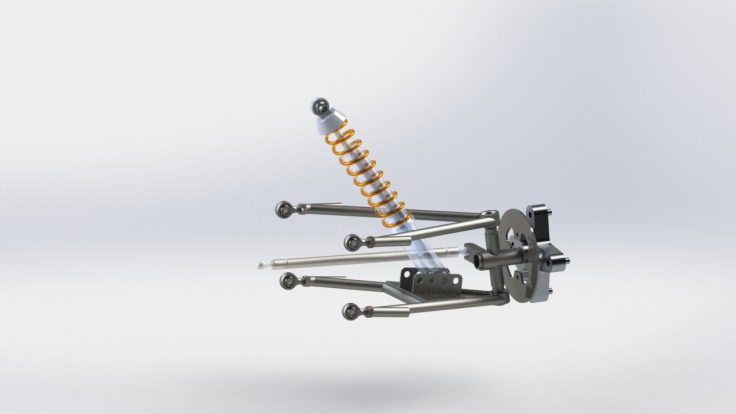
Solidworks front suspension assembly

Solidoworks rendering of the front lower control arm
Rear suspension
The rear suspension is a mutli-link trailing arm design. As with the front, the lower mount of the coilover has motion ratio adjustment. All links have adjustable spherical joints for alignment purposes. The trailing arm is constructed of steel tubing and the upright is constructed of boxed and welded steel plating.
The camber curve was optimized over the full range of travel to gain no more than 0.5 degrees of negative camber on compression and 0.5 degrees of positive camber on rebound. Nominal setting was 0 degrees.
The bump-steer was also optimized to be positive 1/8″ degrees at nominal and change by no more than 1/8″ negative toe on compression and 1/16″ positive toe on rebound.
The nominal thrust angle was set to 8 degrees.
As with the front, the rear hub and disc (not shown) are off the shelf components from a Polaris ATV.

Solidworks rendering of an initial draft of the rear suspension assembly
Frame
Most of the frame design is constrained by the Baja SAE rules. However, for those aspects that are free to modify, again the design tended towards simplicity and ease of manufacturing.


Solidworks isometric, front, and side views of frame
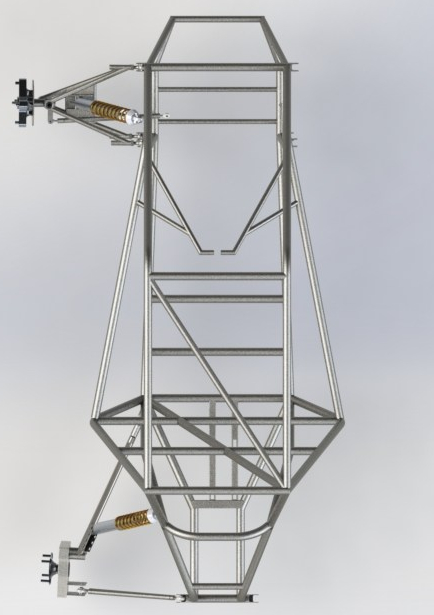
Solidworks rendering of the front and rear suspension assemblies and frame
At the time of my graduation, the front and rear suspension geometry had been optimized for to meet the criteria for camber and toe curves. The first draft of both the front and rear suspension had been made and pending analysis from other club members. The frame had been design to meet the Baja SAE rules and accommodate the Briggs & Stratton motor, CSV, and gearbox. To be completed was mounting tabs for the seat, firewall
 Cory D. Lent